


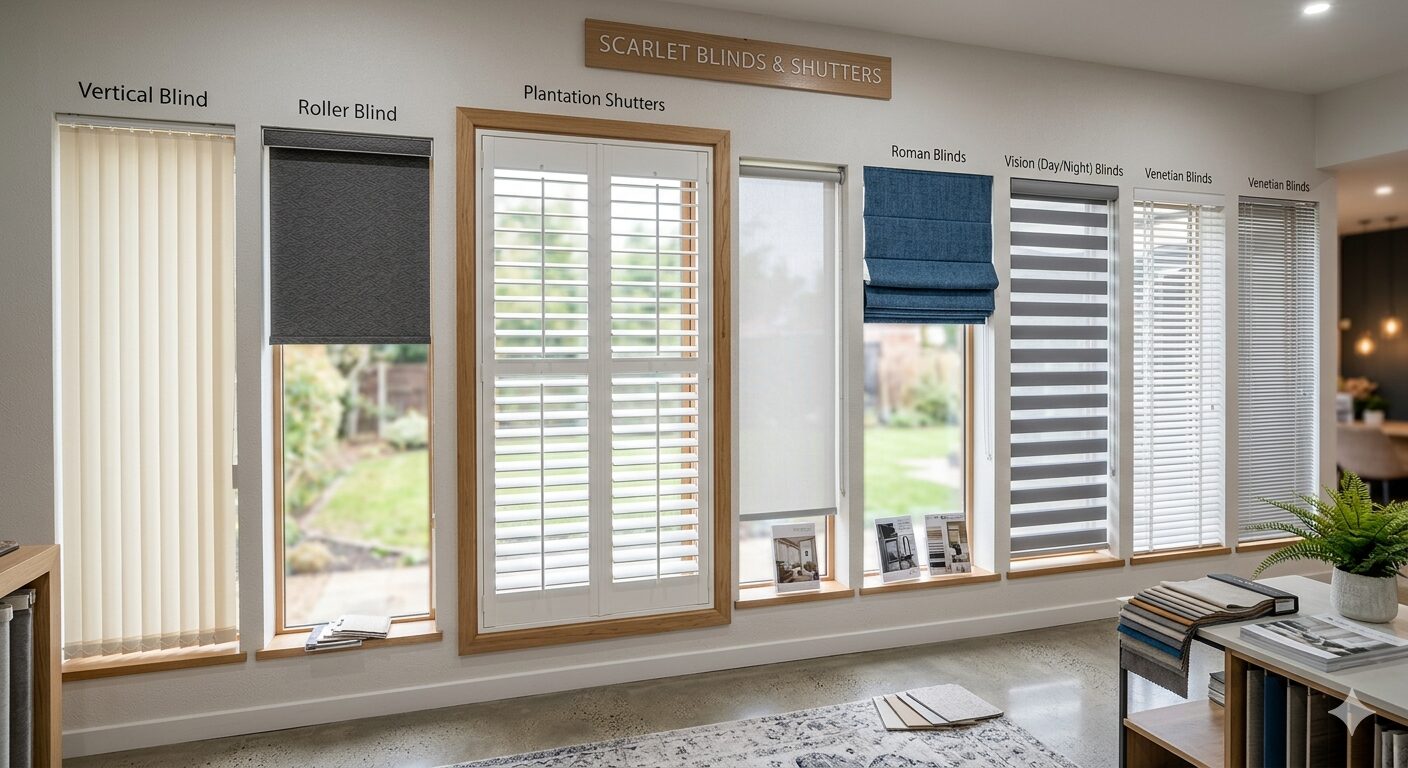
Types of Blinds: A Complete Guide to Choosing the Right Style
There are more types of blinds on the market today than most people expect, and walking into any showroom confronts you with a bewildering range of fabrics, slats, and mechanisms. It is genuinely overwhelming, and most people ask us the same handful of questions before they settle on anything.
Whether you are furnishing a new build, renovating a period property in one of Manchester’s older suburbs, or refreshing a single room, the right choice usually comes down to three things: how much light control you need, how much privacy you need, and what suits the room itself. Here is our honest breakdown of the main types, based on what we actually fit across Greater Manchester every week.
Roller Blinds
Roller blinds remain the most requested style in almost every home we visit, for good reason. A single sheet of fabric rolls around a headrail, sitting neatly at the top of the window when raised.
Best for: kitchens, bathrooms, and bedrooms. Key advantage: genuinely huge fabric choice, including moisture-resistant options for damp rooms and full blackout backings for bedrooms.
Venetian Blinds
Venetian blinds use horizontal slats that tilt to give precise control over light and privacy. We supply three materials, and honestly the right one depends on the room:
- Real wood brings genuine warmth to living rooms and studies, and suits period properties particularly well.
- Faux wood looks close to timber but will not warp or swell in steamy kitchens and bathrooms.
- Aluminium is the lightest and most hygienic option, and wipes clean easily.
Vertical Blinds
Vertical blinds use individual fabric louvres that tilt and slide open horizontally. They are genuinely the best option for large glazing, patio doors, and wide bay windows, since a roller or Venetian blind of that width becomes heavy and awkward.
Best for: sliding doors, conservatory sides, and large windows. Key advantage: excellent light direction, and dust rarely settles on vertical fabric the way it does on horizontal slats.
Roman Blinds
Roman blinds give you the tailored look of curtains with the practicality of a blind. When raised, the fabric folds into soft horizontal pleats, which genuinely warms up a room in a way hard fabrics cannot.
Best for: bedrooms and formal living rooms. Key advantage: a thick or blackout lining adds real thermal insulation, useful in older Manchester housing with single or early double glazing.
Perfect Fit Blinds
Perfect Fit blinds clip directly into the bead of a uPVC window frame, with no drilling, no screws, and nothing fixed to the wall. The blind sits flush inside the frame and moves with the window handle rather than getting in its way.
Best for: conservatory doors, tilt-and-turn windows, and French doors. Key advantage: leaves the sill completely clear, and installs without marking paintwork.
Day and Night Blinds
Day and night blinds, also called zebra blinds, use two layers of alternating sheer and solid fabric on a single roller. Move the chain slightly and the stripes shift into or out of alignment, letting you switch between soft daylight, partial privacy, and full blackout with the same blind.
Best for: street-facing living rooms and home offices, where you want flexibility rather than a fixed setting.
Comparing Types of Blinds by Room
| Blind Type | Best Room | Main Benefit |
|---|---|---|
| Roller blinds | Kitchen, bathroom | Easy to wipe clean |
| Faux wood Venetian | Damp or humid rooms | Will not warp |
| Roman blinds | Bedrooms, living rooms | Thermal warmth |
| Vertical blinds | Large glass doors | Easy light control |
| Perfect Fit | French doors, uPVC | No drilling |
How to Choose Between the Types of Blinds Above
Before you order, it is worth working through three honest questions.
How damp is the room? For kitchens and bathrooms, choose wipe-clean PVC or faux wood over delicate fabrics that can mark or mould. If you have young children, the RoSPA guidance on blind cord safety is worth a look regardless of which type you choose.
How much darkness do you need? For bedrooms and nurseries, a blackout lining helps, but the fitting matters more than the fabric. Blinds fitted outside the recess, overlapping the frame on each side, block far more light than the same blind fitted inside it. We cover this properly in our guide to blackout blinds for bedrooms.
How does your window open? If your windows tilt or turn inward, a framed option like Perfect Fit avoids the blind catching on the handle when it opens.
Book a Free Home Consultation
Every window is different, and the right blind for your room is rarely obvious from a website alone. We measure every job ourselves, bring genuine fabric samples to your door, and give honest advice rather than push whatever is easiest to sell.
We cover Manchester and Greater Manchester, including Middleton, Oldham, Rochdale and Bury.
Call 01617062233 for a free, no obligation quote, or see our full range of plantation shutters if you are considering something more permanent.