


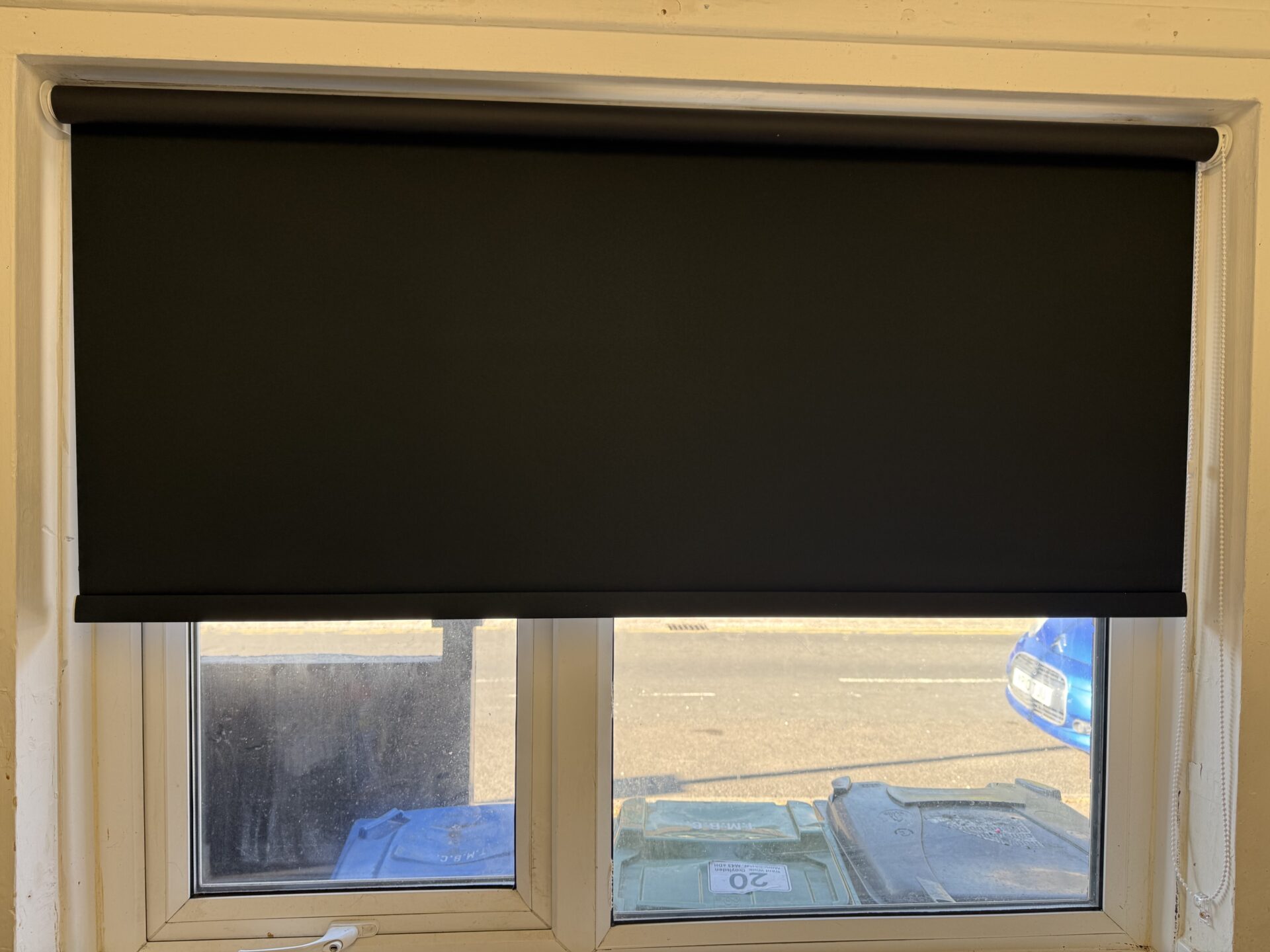
Blackout Blinds for Bedrooms: An Honest Guide for Manchester Homes
Most people who buy blackout blinds for a bedroom are disappointed the first morning. The room is darker, certainly, but it is not dark. Light still runs down both sides of the blind and along the top, and at five in the morning in June that thin strip is enough to wake you.
The fabric is rarely the problem. The fit is. This guide explains what actually makes a bedroom dark, and what to ask for when you order.
Why Blackout Blinds Leak Light
A blackout fabric blocks light passing through it. It cannot block light going round it.
Fitted inside the window recess, a blind is made slightly narrower than the opening so it can operate without catching. That clearance leaves a gap of a few millimetres down each side. There is usually another gap between the top of the headrail and the top of the recess, which throws a line of light along the ceiling.
Consequently, a room with a well made blackout blind can still be noticeably light at dawn. The blind is doing its job. The gaps are not.
Three Ways to Close the Gaps
Fit Outside the Recess
Mounting the blind on the wall above the window, wider than the opening on both sides, is the simplest fix. The fabric then overlaps the frame rather than sitting inside it. This alone removes most of the side leak, and it costs nothing extra.
Make the Blind Wider Than the Window
An outside recess blind should overlap the opening by several centimetres on each side, not sit flush with it. That overlap is what stops light escaping down the edges. We work this out at the measure, because the right amount depends on the depth of your recess and where the frame sits.
Use a Pelmet
A pelmet or valance across the top closes the gap above the headrail. Because that gap sits at eye level when you are lying down, it often bothers people more than the side gaps do.
Which Blackout Blind Suits a Bedroom?
Roller Blinds
Blackout roller blinds are the most common choice, and for good reason. They are simple, they sit flat, and the fabric is a single coated layer that blocks light completely. Fitted outside the recess with a generous overlap, they give the most reliable darkness of any option.
Roman Blinds
Roman blinds with a blackout lining suit bedrooms where you want something softer than a roller. The folds add warmth to a room. However, the lining is stitched behind the fabric rather than bonded to it, so a small amount of light can pass at the seams.
Pleated and Honeycomb Blinds
Honeycomb blinds have a cellular structure that traps air, which means they insulate as well as darken. They also sit closer to the glass than a roller does, so the side gaps are smaller to begin with. In a cold bedroom, this is genuinely the option that does two jobs at once. Our pleated blinds range covers similar ground.
Blinds Behind Curtains
Where absolute darkness matters, the strongest combination is a blackout blind inside the recess with lined curtains over the top. The blind handles the window, the curtains handle the edges. It is more expensive than either alone, but nothing else gets closer to complete darkness.
The Manchester Problem: Street Lighting
Fabric and fitting matter more here than in most places, and it is worth being specific about why.
Terraced streets across Manchester tend to have street lamps close to the front of the house, often level with the first floor windows. In Longsight, Levenshulme, Gorton and Openshaw you frequently find a lamp within a few metres of a bedroom window. That is a light source running all night, at close range, at exactly the height of the bed.
Consequently, a blind that would be perfectly adequate in a detached house set back from the road often is not enough here. Fitting outside the recess makes a bigger difference on a terraced street than it does anywhere else.
Bay windows bring their own complication. A bay is three or five separate windows, so a blackout blind is needed for each section, and each joint is another potential gap. We cover the approach to bays in our guide to plantation shutters, which handle bay geometry particularly well.
Blackout Blinds for Children’s Rooms
Two things matter more in a child’s room than anywhere else.
Darkness in summer. Getting a small child to sleep at half past seven in June is considerably easier in a dark room. This is the single most common reason parents in Greater Manchester ring us about blackout blinds.
Safety. Cords and chains are a genuine hazard. All our blinds meet UK child safety regulations, and cordless and motorised options remove the risk entirely. RoSPA has clear guidance on blind cord safety that is worth reading if you have young children.
Do Blackout Blinds Help with Heat?
Yes, though less than people expect from a standard roller. The coated fabric does reflect some heat, but a single layer sitting a few centimetres from the glass has limited effect.
Honeycomb blinds are genuinely different. The cells trap a layer of still air against the window, which slows heat loss in winter and heat gain in summer. In an older Manchester bedroom with single or early double glazing, that is a real difference rather than a marketing claim.
What to Ask For When You Order
If you take nothing else from this guide, ask about these four things:
- Fit type. Outside recess is darker than inside recess. Say which you want and why.
- Overlap. Ask how far the blind will extend past the window on each side. More overlap means less light.
- Fabric type. Coated blackout blocks all light. Dim-out fabric does not, despite often being sold alongside it.
- Cordless operation. Standard on our range, but always confirm, particularly for a child’s room.
Common Questions
Do blackout blinds block all light?
The fabric does. The gaps around it do not, unless the blind is fitted outside the recess with a generous overlap. That distinction is the whole point of this guide.
What is the difference between blackout and dim-out?
Blackout fabric is coated and blocks light entirely. Dim-out reduces brightness by most of the way but still lets some through. For a bedroom, blackout is the one you want.
Can I have blackout blinds in a bay window?
Yes. Each section needs its own blind, and the heights should match across the bay so the blinds line up properly.
Are blackout blinds safe for a nursery?
Cordless and motorised options are, and we would recommend one of those for any child’s room. Corded blinds should be avoided entirely where young children sleep.
Book a Free Home Visit
Getting a bedroom genuinely dark is a measuring and fitting question more than a fabric question. We come out, look at the window, and tell you honestly whether an inside recess fit will do the job or whether you need to go outside the recess for proper darkness.
We cover Manchester and Greater Manchester, including Middleton, Oldham, Rochdale, Bury and Longsight.
Call 01617062233 for a free, no obligation quote, or see our full range of blackout blinds.