


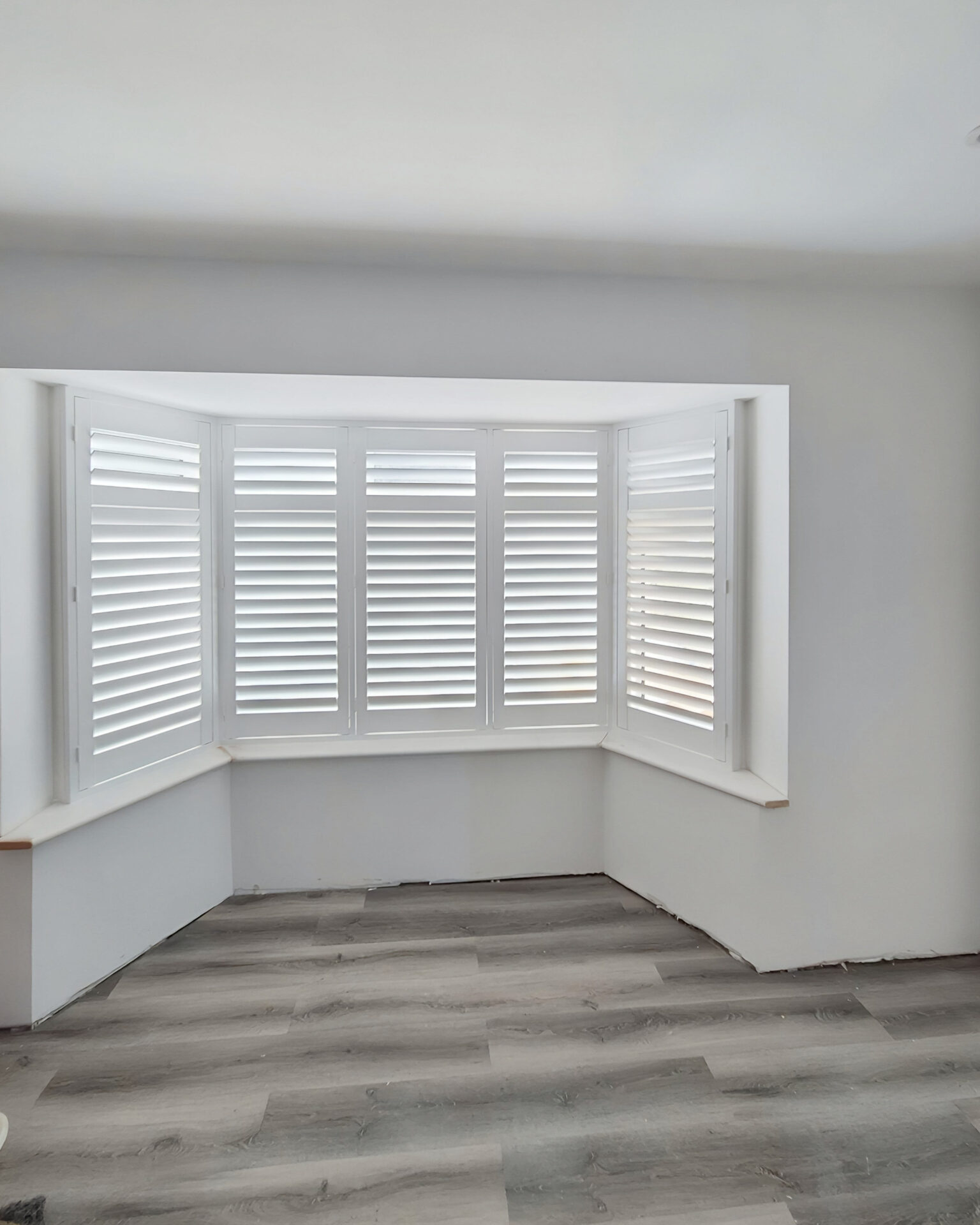
Shutters for Bay Windows: A Practical Guide for Manchester Homes
Shutters for bay windows solve a problem most other window coverings cannot. Bay windows are one of the best features a house can have, and one of the hardest to dress properly. Greater Manchester has thousands of them. Walk through the Victorian terraces in Chorlton, the Edwardian semis around Didsbury, or the older streets of Rochdale and Bury, and you will find bay after bay after bay.
Curtains rarely do them justice. Blinds can work, but often leave awkward gaps at the angles. Shutters, fitted properly, are usually the answer. Here is what genuinely matters when you are choosing them.
Why Shutters for Bay Windows Work So Well
A bay is really three or five separate windows meeting at angles. That geometry is exactly what defeats most window coverings. A curtain pole has to either cut across the bay or be expensively curved. Roller blinds leave triangular gaps where the panes meet.
Shutters solve this because each panel is made to fit its own section of the bay. Consequently, you get full coverage with no gaps, and the frame follows the shape of the window rather than fighting it.
There is a practical benefit too. Older Manchester housing often has single glazing or early double glazing in the bay, and bays lose heat faster than flat walls because there is more glass. Shutters add a genuine insulating layer. In a cold front room, you notice it.
The Three Main Styles of Shutters for Bay Windows
Full Height Shutters
These cover the whole window in one continuous run of panels. They give the cleanest, most architectural look, and they are the most popular choice for bays.
On taller Victorian bays, a midrail is added partway up. This is a horizontal divider that lets you tilt the top and bottom louvres independently. As a rule, any shutter over roughly 1500mm tall needs one, both for strength and for control.
Best for: living rooms and bedrooms where you want a balanced, uncluttered finish.
Tier on Tier Shutters
Tier on tier means two separate sets of panels, one above the other, each opening independently. You can fold the top panels right back for light while the bottom stay shut for privacy.
For a bay that faces directly onto a street, this is usually the most practical option. Many Manchester terraces have the front bay a few feet from the pavement. Tier on tier lets you have daylight without feeling watched.
Best for: street-facing bays in terraced and semi-detached homes.
Café Style Shutters
Café style covers only the lower portion of the window, leaving the top open. The room stays bright while anyone at pavement level cannot see in.
It suits bays that are not heavily overlooked and rooms where light matters more than full privacy. However, it does mean no coverage at all after dark on the upper section, which is worth thinking about in a bedroom.
Best for: kitchens, dining rooms and bright front rooms.
Bay Shapes and What They Need
Not all bays are the same, and the shape genuinely affects the fitting.
Square or box bays have two right angles and a flat front. These are the most straightforward to fit.
Angled or canted bays meet at obtuse angles, typically 135 degrees. Each joint needs a shaped post so the panels close properly against each other. This is standard work, but it has to be measured accurately.
Bow windows curve gently across four or five sections. These need the most careful measuring, since each section sits at a slightly different angle.
Why Measuring Matters More on a Bay
This is the part most people underestimate, and it is where poor fitting shows up worst.
Every panel across a bay should share the same height, even if the window sections vary slightly. If the heights differ by even a few millimetres, the number of louvres can change between panels, and the midrails will not line up. The result is a bay where the slats are visibly out of alignment from one section to the next.
Once it is built that way, it cannot be adjusted. Therefore, getting the measurements right first time is not a detail, it is the whole job. This is genuinely why we measure every bay ourselves rather than working from customer measurements.
Choosing the Right Material
Material choice depends mostly on where the bay is and how much sun it gets.
Basswood is the standard choice for most bays. It is light, stable, takes paint well, and suits period properties particularly well.
Paulownia is lighter still, which helps on very wide panels where weight becomes a factor.
Aluminium core PVC is fully waterproof. If the bay is in a kitchen, a bathroom, or gets strong direct sun for much of the day, this is the sensible option. Real timber can warp under sustained heat and UV, so a south-facing bay is worth thinking about carefully. Our shutter components are supplied by UK manufacturers including Louvolite.
Shutters or Blinds for a Bay?
Shutters are not automatically the right answer, and it is worth being straight about that.
Blinds cost less. If budget is the main consideration,vertical blinds, roller blinds or Venetian blinds can be fitted individually to each section of a bay and will do a decent job.
Shutters cost more but last far longer, insulate better, and tend to add value rather than needing replacing every few years. On a bay specifically, they also look considerably better, because the frame follows the architecture instead of sitting awkwardly across it.
Common Questions
Can shutters for bay windows be fitted to any shape?
Almost always, yes. Square, angled and bow bays can all be fitted with made to measure shutters. Unusual or shaped windows may need a survey first, but very few bays genuinely cannot be done.
Which style is best for a street-facing bay?
Tier on tier, in most cases. Keeping the lower panels closed and the upper panels open gives you privacy at pavement level while the room stays bright.
Do shutters help with heat loss?
Yes. A bay has more glass than a flat wall, so it loses heat faster. Closed shutters trap a layer of still air against the glass, which genuinely reduces that loss.
Can I still open the windows?
Yes. Panels are hinged so they fold back, and we plan the layout around opening lights and handles as part of the measure.
Book a Free Bay Window Survey
Bays are the one job where measuring properly makes all the difference. We come out, measure every section ourselves, and talk through which style genuinely suits the room rather than which is easiest to sell.
We cover Manchester and Greater Manchester, including Middleton, Oldham, Rochdale, Bury and Bolton.
Call 01617062233 for a free, no-obligation survey and quote. Alternatively, see our full range of plantation shutters.